
- Since 2018Cleaning and maintaining commercial buildings across the North West
- Fully insuredComprehensive public liability cover on every job
- Trained teamsAccredited operatives, trained for work at height
- 24 hoursTypical turnaround on a written quote
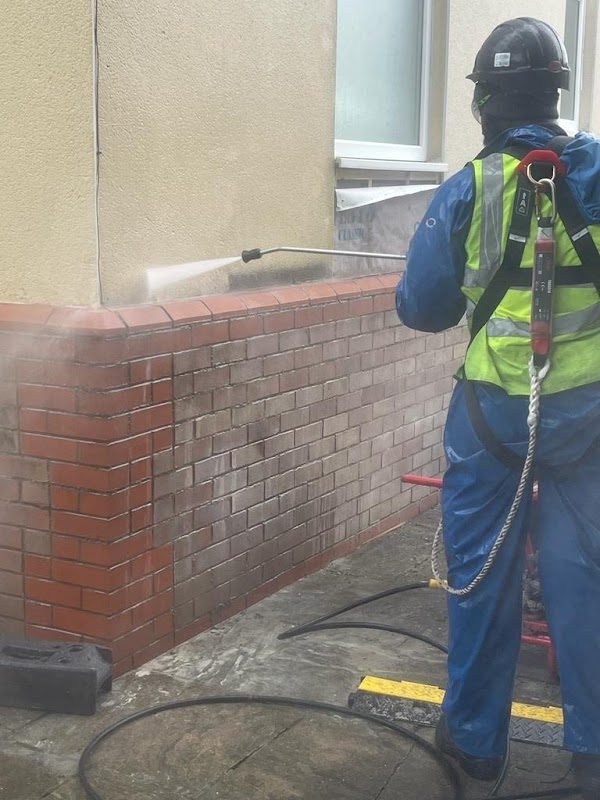
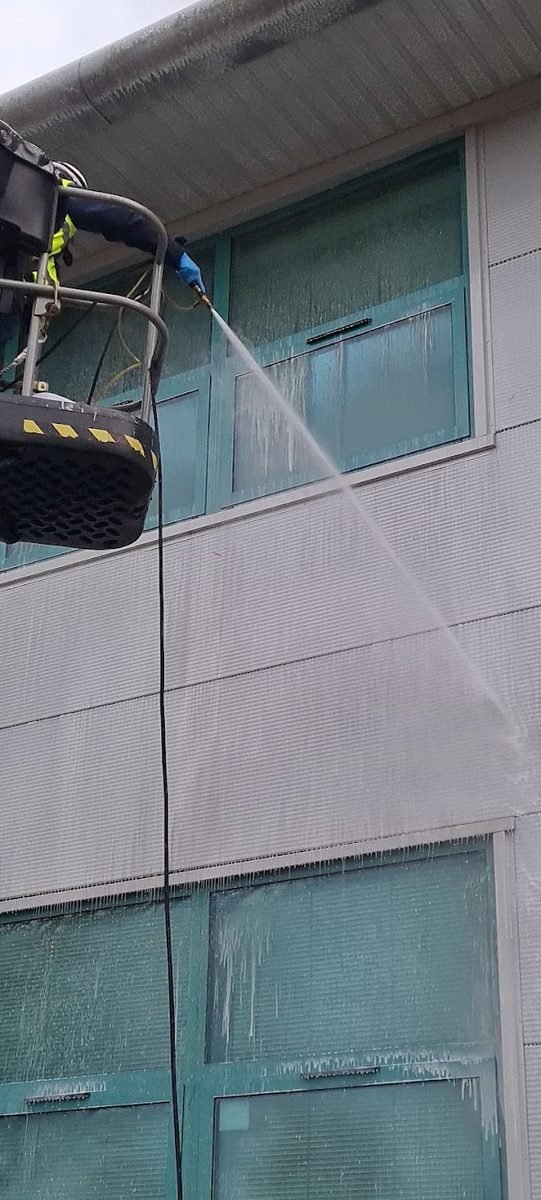
DOFF is a superheated water system that cleans at up to 150°C but at very low pressure. The heat does the work, not force, which is why it lifts moss, algae, lichen, bitumen, paint and carbon soiling without eroding the surface underneath.
That combination makes it the accepted method for listed buildings, churches, town halls and conservation area frontages, where a pressure lance or grit blasting would cause irreversible damage and, quite possibly, an enforcement notice.
What DOFF removes
Moss, algae, lichen and biological growth, and because the steam is above 100°C at the nozzle it kills the spores rather than just removing the visible growth. Regrowth is much slower as a result.
It also handles paint and graffiti, bitumen and tar, chewing gum, carbon and diesel soiling on city centre stonework, and old limewash and cement residue during restoration work.
Surfaces it suits
Sandstone, limestone and granite, brick and terracotta, lime render and pebbledash, concrete and stone paving, statuary and monuments.
It is not the right answer for everything. Painted timber, some soft lime mortars and certain render finishes need a different approach, and we will tell you before we start rather than discover it on your elevation.
Listed and conservation work
If your building is listed or in a conservation area, cleaning may require consent, and the specified method matters. DOFF is widely accepted by conservation officers and Historic England guidance because it is non-abrasive and uses very little water.
We can carry out a test patch for your conservation officer to inspect and sign off before the main works begin. That step is worth doing every time.
Why DOFF over pressure washing
-
No abrasion
Low pressure means the surface is not eroded, so detail, tooling marks and pointing survive.
-
Very little water
Minimal water use, so masonry does not become saturated and there is no runoff to manage.
-
Kills spores
Steam above 100°C destroys the biological growth at the root, slowing regrowth substantially.
-
Chemical free
In most cases no chemicals are needed at all, which matters near planting, watercourses and the public.
Ready for a price?
Send a few photos and a postcode and we will come back with a fixed written quote, usually within one working day.
Frequently asked questions
Yes, and it is the method most often specified for them. It is non-abrasive and low pressure, so it does not erode the stone face or open up joints. Do still check whether listed building consent is required before any cleaning starts.
Pressure washing uses force and a lot of cold water. DOFF uses heat, very low pressure and a small volume of water. On historic masonry, force removes the weathered surface layer along with the dirt, and you cannot put that back.
Sound pointing is unaffected. Failed or badly eroded pointing may lose loose material, which is arguably a good thing since it needed repointing anyway. We survey the elevation first and flag anything that needs attention.
Yes, in most cases, sometimes with a poultice or gel applied first on stubborn or deeply absorbed paint. Historic stone is porous, so a test patch is always the first step.
Often, yes. Cleaning can be treated as an alteration to a listed building. Talk to your local conservation officer early. We can provide a method statement and a test panel to support the application.
More from this kind of job
Where we work
We are based in Manchester and cover the whole of the North West from here. For roof work and multi-site contracts we travel nationally, and have worked on sites from Bristol to Leicester. If your site is not on the list, ask anyway.
- Manchester
- Liverpool
- Chester
- Warrington
- Preston
- Blackpool
- Lancaster
- Bolton
- Stockport
- Wigan
- Rochdale
- Salford
- Leeds
- Sheffield
Other services you might need
Request a quote
Send us the details and we'll come back with a fixed price. No pressure, no sales calls.